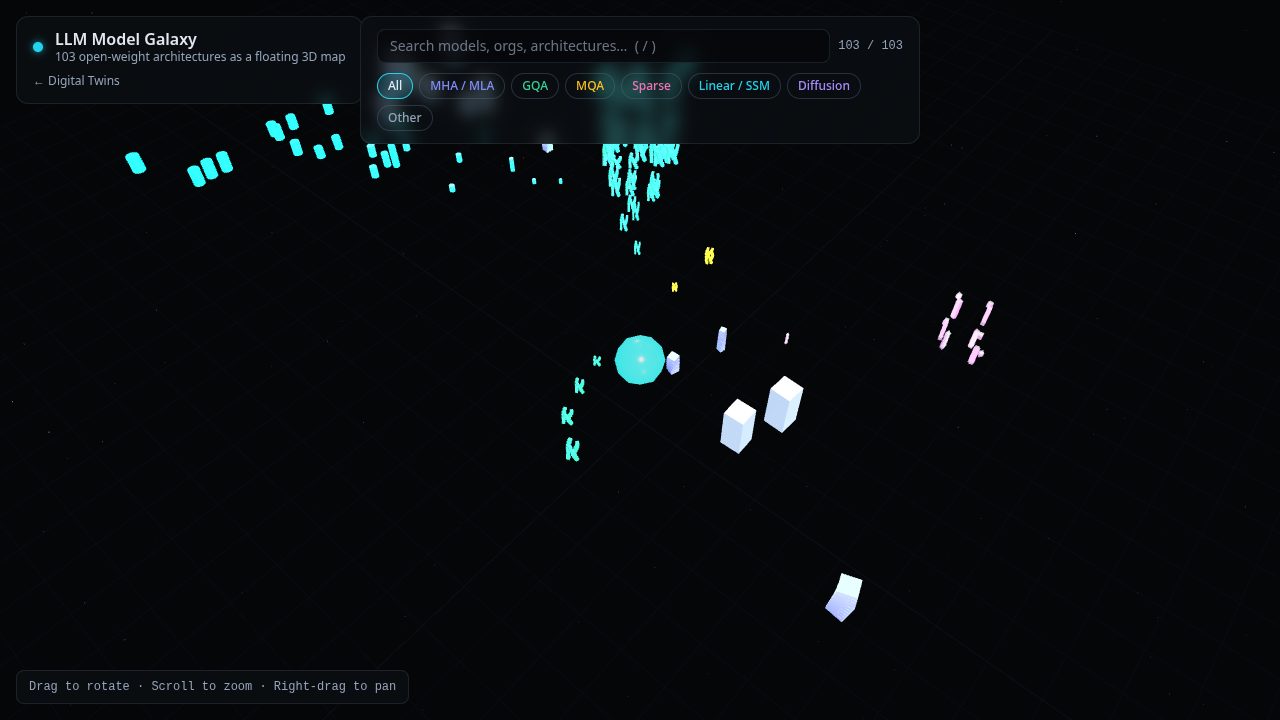
Every agency has one thing it cannot stop fiddling with. Ours is not a framework, a model, or a cloud, it is the way people see AI systems. Visualizing AI architecture is the area we are solely obsessed with improving, and this week that obsession produced something we are genuinely proud of: the LLM Model Galaxy, a floating 3D map of 103 open-weight transformer architectures you could fly through in your browser. The interactive demo has since been retired, but the source data and the write-up live on below.
What you are looking at
Each glowing crystalline stack is one model family, GPT, Llama, Qwen, DeepSeek, Mistral, Kimi, and dozens more, built from the metadata in Sebastian Raschka's excellent LLM Architecture Gallery, plus architectures we model ourselves, like the recent SparDA decoupled sparse-attention design. The galaxy encodes four facts about every model at once:
- Color and cluster: the attention family: GQA, multi-head and latent attention, multi-query, sparse, linear/SSM, and diffusion each occupy their own spiral arm.
- Distance from the core: parameter scale, on a log axis. The heavyweights drift to the rim.
- Angle around the core: release year, so orbiting the galaxy is orbiting time.
- Stack height: layer count, so deep models literally tower.
Hover any stack for its name and family. Click it and a fact sheet slides in: parameters, layers, context length, vocab, license, and a link to the technical report or config. A search bar and family filters let you answer questions like "show me every sparse-attention model" in one keystroke, press /, type, done.
Why we keep building these
The galaxy joined the interactive twins on our Digital Twins page — the same obsession wearing different clothes. The Rack Explorer lets you walk a Vera Rubin NVL72 down to the chip. The Exploded Twin pulls a desktop AI supercomputer apart layer by layer with dimension callouts. The Transformer Pipeline shows tokens flowing through attention as a live machine. The galaxy zoomed all the way out: not one machine or one model, but the whole design space of modern LLMs at a glance.
We believe architecture literacy is becoming a core engineering skill. Choosing between GQA and MLA, or understanding why a sparse-attention design can offload its KV cache without stalling the GPU, is much easier when you can see the trade-offs instead of reading another table of acronyms. Papers with beautiful figures, Raschka's gallery being the gold standard, prove the appetite. We wanted the figure you can fly through.
How it is built
Everything is a self-hosted static site: Three.js, procedural geometry, and a committed JSON snapshot of the model metadata. No backend, no tracking, no viewer lock-in. A small Python fetcher re-syncs the snapshot with the upstream gallery, and a local extras file carries architectures, like SparDA, that have not been carded yet. The whole thing deploys to Cloudflare Pages alongside the rest of our demos.
If you have a system, model zoo, or hardware lineup that deserves this treatment, that is exactly the work we do. Explore the demos, or book a strategy call and tell us what you want to see.